
Blaine County Criminal Court Records
A Blaine County criminal court record is the case file kept by the court once a complaint, information, indictment, warrant, summons, or related charging event opens a case. It is broader than a charge list. The criminal file can include the charging document, warrant or summons entries, arraignment minutes, bail conditions, preliminary hearing entries, motions, hearing notices, plea, trial entries, disposition, judgment, sentence, probation conditions, restitution, and payment activity.
Criminal cases route through Idaho's unified trial-court structure. Misdemeanor cases and preliminary felony hearings are heard in the Magistrate Division, while felony trials and higher criminal matters move through District Court. Both operate locally from the Douglas Kramer Judicial Building under the Fifth Judicial District. Clerk Stephen F. Graham's court-records function handles case copies, while Sheriff Morgan Ballis's office may keep separate arrest, jail, or report records. The full criminal case file should be read alongside the docket because a docket line may show that an order exists without showing the order text.
The Blaine County Prosecuting Attorney source is assigned to the first criminal court records image.
The prosecutor matters to the court record because formal filed charges begin with a charging decision, not with the booking entry alone.
Search Blaine County Criminal Court Records
Use the Idaho iCourt Portal for public criminal case lookup. Blaine County's records instructions direct users to iCourt for name or case-number searches because the local office does not conduct searches. Smart Search can locate the case, Search Hearings can show court dates, and Make Payments can show criminal or traffic fine payment paths when the case is eligible for online payment.
- Search iCourt by defendant name or case number. Use spelling variations when needed.
- Confirm Blaine County, District Court or Magistrate Division, case type, and filing date before relying on a result.
- Read the docket for arraignment, preliminary hearing, motions, plea, disposition, sentence, and payment events.
- Separate each charge line from the case outcome because one case can contain several charges with different results.
- Request public judgments, pleadings, or sentencing documents from Blaine County court records after collecting the case number and document title.
For the narrower arrest-to-charge path, use Blaine County arrest records and court charges. The criminal court record remains the better source for pleas, disposition, sentence, probation, and final judgment.
Blaine County Criminal Case Flow
The county's criminal justice process starts with a crime report, investigation by city police, the county sheriff, or Idaho State Police, and a charging decision by the appropriate prosecutor. A case with probable cause may be referred to a City Prosecuting Attorney for city misdemeanor or infraction matters inside city limits, or to the County Prosecuting Attorney for felony, county misdemeanor or infraction, and juvenile matters.
Case flow: Charges Filed › Arraignment › Preliminary Hearing or Pretrial › Motions › Plea or Trial › Disposition › Sentencing
| Stage | What Happens |
|---|---|
| Charges Filed | The prosecutor files a complaint or a grand jury returns an indictment. The court may issue a warrant or summons. |
| Arraignment | The defendant is advised of rights, charges, possible penalties, plea options, and bail or release conditions. |
| Preliminary Hearing | For felony matters, the court decides whether enough cause exists for the charge to proceed. |
| Pretrial and Motions | Parties file requests, notices, discovery-related material, and orders that shape the case before resolution. |
| Plea or Trial | The case resolves by plea, trial verdict, dismissal, or other court action. |
| Disposition and Sentencing | The docket and judgment show final charge outcomes, sentence, probation, fines, restitution, or dismissal. |
The county criminal justice process source is assigned to the criminal case flow image.
The image source supports the key sequence from report and investigation through charging, arraignment, and preliminary hearing.
What Blaine County Criminal Records Show
Criminal court records combine case identity, charge identity, hearing history, financial items, and outcome data. They may also show links between court events and custody conditions, such as bond or no-contact orders. Do not assume a charge line is the final result. A case may show charges that were amended, reduced, dismissed, or resolved differently at sentencing.
| Field | What It Shows |
|---|---|
| Case Number | The court identifier used for lookup, hearing review, copy requests, and payment questions. |
| Defendant | The person charged in the criminal case, with public party details controlled by court access rules. |
| Charge and Statute | The formal allegation, code reference, level, and charge count when visible. |
| Arrest, Warrant, or Summons | How the defendant was brought before the court when that event is public. |
| Hearings | Arraignment, preliminary hearing, pretrial conferences, trial settings, and sentencing dates. |
| Plea | The defendant's response to the charge when entered and public. |
| Disposition | The outcome of each charge, such as guilty plea, dismissal, acquittal, or other court result. |
| Sentence | Jail, prison, probation, fines, restitution, court costs, and conditions when ordered. |
| Financials | Fines, fees, bonds, restitution, payments, refunds, or outstanding balances. |
Charges vs Convictions
A charge is an accusation filed in court. A conviction is a finding or plea that establishes guilt. Blaine County criminal court records can show both, but they are not the same. One arrest or complaint may produce several charge counts, and each count can end in a different way. The disposition and sentencing fields are the key places to look for the actual outcome.
| Point | Charge | Conviction |
|---|---|---|
| Meaning | Formal allegation that a law was violated. | Guilty plea, finding, or verdict establishing guilt. |
| Timing | Appears early after complaint, indictment, warrant, or summons. | Appears after plea, verdict, or other final court action. |
| Record Clue | Charge list, statute, level, and count number. | Disposition, judgment, sentence, and probation terms. |
| Can Change | May be amended, reduced, added, or dismissed. | May be affected by appeal, relief, or later court order. |
Blaine County Criminal Defense Records
Public defender applications are part of the criminal-court process but are not ordinary public case records. The Blaine County public defender information says a person should complete the application and file it with the office or bring it to first appearance. A judge reviews income, assets, and liabilities. Unless otherwise notified, public defenders are not available to consult before first appearance.
The Blaine County public defender source is assigned to this criminal court records image.
The application process can affect early court events, but financial eligibility records and attorney communications are not treated as public docket material.
Sealed vs Expunged Criminal Records
Idaho criminal record relief is more precise than the general word expungement. Sealing limits public access to qualifying records, and juvenile offender records have their own sealing rule. Idaho Code 19-2604 can allow certain defendants, after qualifying probation or discharge, to seek dismissal or relief from some plea or conviction consequences. It is not a promise that every adult criminal record disappears.
| Point | Sealed | Expunged / Dismissal Relief |
|---|---|---|
| Public Visibility | Hidden from public portal results or public document access as ordered. | Depends on the statute and order; Idaho research supports dismissal relief for qualifying cases, not blanket erasure. |
| Where Filed | In the court that handled the case or under the rule that controls the record. | In the court that handled the case when Idaho Code 19-2604 applies. |
| Juvenile Matters | Juvenile offender records are governed by Idaho Code 20-525A. | Adult relief does not replace juvenile sealing rules. |
| Official Access | Law-enforcement or official access may still exist depending on the order. | Official consequences depend on the statute, order, and agency record involved. |
Idaho Code 19-2604 is the assigned relief statute image for Blaine County criminal court records.
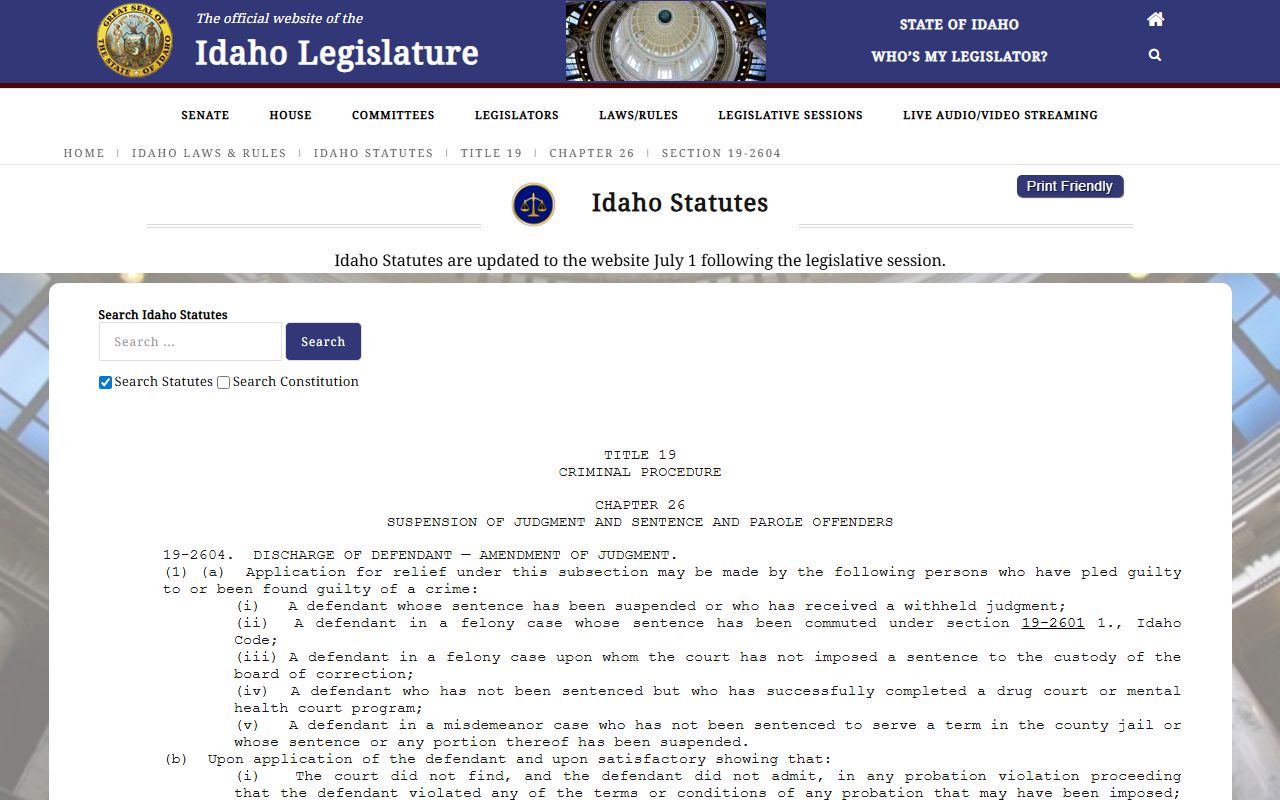
The statute should be read with the case docket, judgment, sentence, and probation or discharge documents before any relief request is evaluated.
Blaine County Criminal Record Access
Criminal case access is governed by ICAR 32 for judicial records. The public can use iCourt to find public case and hearing information, and the local court records office can provide public copies from a specific case. Sealed cases, sealed events, juvenile records, minor information, protected addresses, financial account numbers, health information, and some victim data may be withheld or redacted.
Blaine County's records process requires a written request for copies and enough detail to identify the document. Copies cost $1.00 per page, certified copies cost an added $1.00 per document, and the office has 72 hours to review and respond. Court audio is available only for a specific trial or hearing within the appeal period and cannot substitute for an official transcript.
Important: Criminal court lookup is not a consumer report and must not be used for FCRA-regulated screening.
Blaine County Criminal Case Programs
Some criminal cases may include problem-solving court activity after sentencing or as part of supervision. The Fifth Judicial District Drug Court source lists Blaine testing and treatment support at KH Counseling & Health Center in Hailey. DUI Court also exists in the Fifth Judicial District and includes Blaine-area treatment contact information. These programs are not separate public-record databases. They appear in the criminal case context when ordered by the court.
The Fifth District Drug Court source is assigned to one Blaine County criminal court records image.
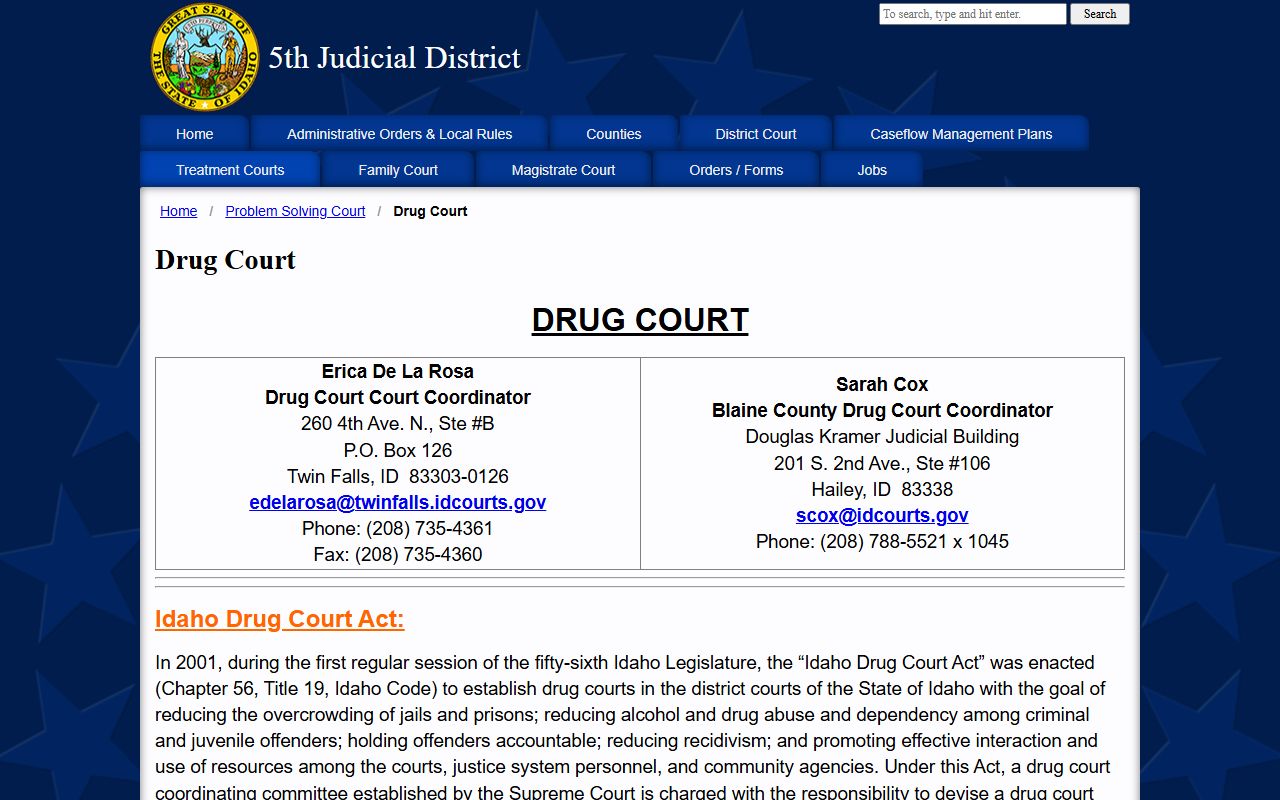
Drug Court records should be read as part of the criminal supervision and sentencing context, not as a stand-alone search system.
The Fifth District DUI Court source is assigned to the final criminal court records image.
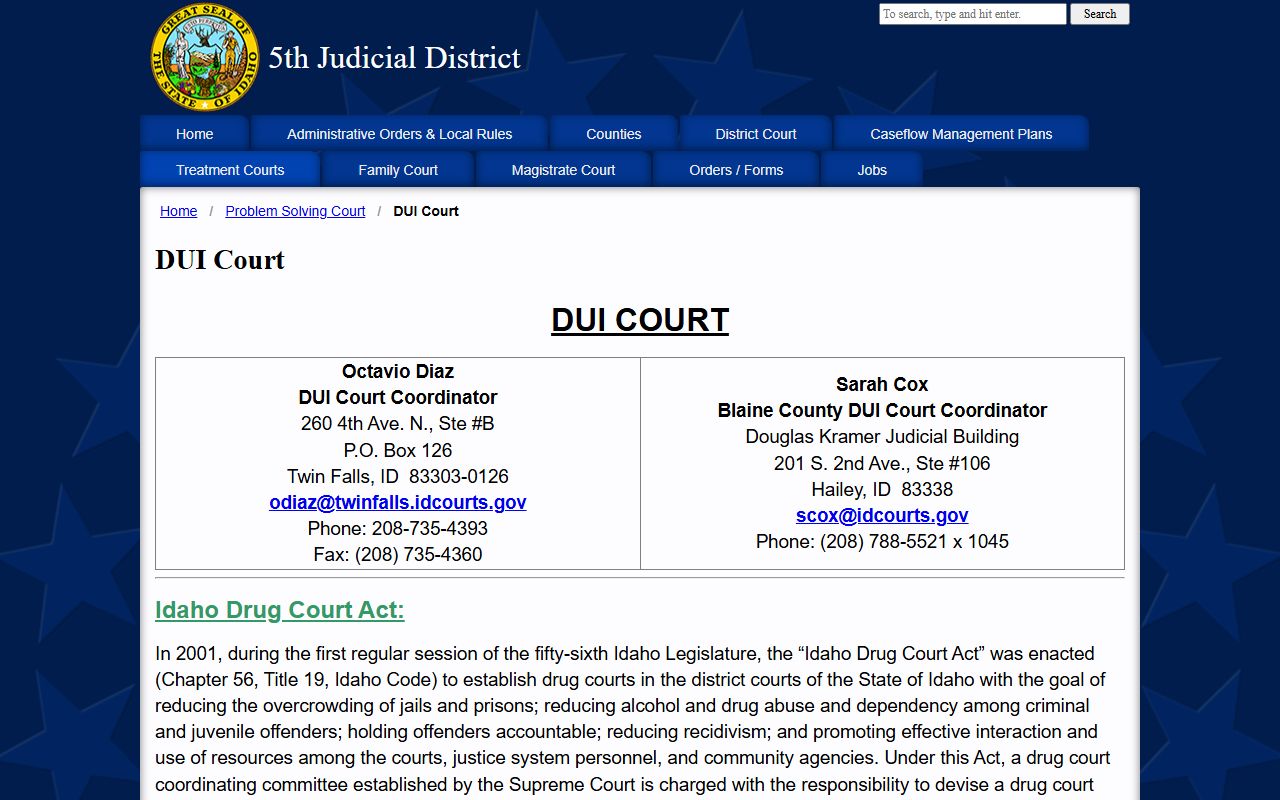
DUI Court information can explain a sentence or supervision path, while the criminal case file remains the source for the filed charge, disposition, and sentence.